Bake plates have several advantages over convection type ovens
1) Decreased bake time 2) Increased reproducibility 3) Better film quality This section will describe these differences and set a few guidelines for using hotplates.

1) Decreased bake time 2) Increased reproducibility 3) Better film quality This section will describe these differences and set a few guidelines for using hotplates.
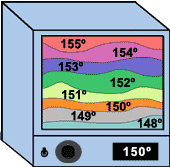 Stratification, the formation of different temperature zones, is a problem associated with convection ovens and can severely affect film quality and reproducibility.
The heating rate of a substrate in an oven depends not only on the heated air flow past a substrate but also on its proximity to other cold substrates. Thus the heating rate for each substrate in a cassette of substrates that are being baked, will be less than if each substrate is baked alone.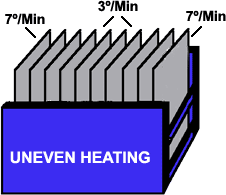
In addition, substrates near the ends of a cassette heat faster than the substrates in the middle, thus producing a non-uniform heating.
Particle generation also occurs within a standard oven. In a forced-air, convection oven, substrates are commonly exposed to a flow of particle laden air for at least 30 minutes.
During resin film cures, the substrates will be exposed to considerable particulate contamination. The substrates are vulnerable since the film may still contain solvents and during this ‘soft’ state, the film is very susceptible to having particles adhere to it.
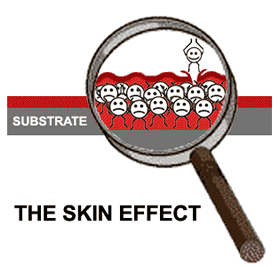 Another disadvantage in normal oven baking results from baking substrates from the “outside in”. Since heat is applied to the outer surface of the film first, a skin forms on the surface of the film thus trapping solvents. Upon vaporizing, these solvents form blisters or bubbles which results in adhesion loss or even bulk film failure. This problem prevails in processes involving thick film resins, e.g. polyimides.
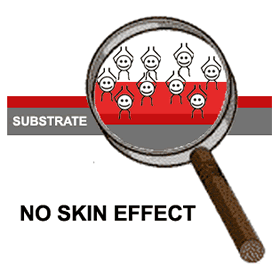 No skin effect occurs on a hotplate since hotplate baking heats the substrate from the bottom up. This “inside out” approach offers advantages for thick films since solvents in the film nearest the substrate are baked off before the fim surface seals over.
A well designed hotplate insures uniform baking across the substrate. Since the substrate intimately contacts a surface of a known constant temperature, it heats at a rate dependent only on the bake style selected and the thermal properties of the substrate.
Increased throughput results from a faster warmup of the substrate. Bake times will be measured in seconds, rather than minutes or hours, as in conventional ovens.
Reduced vulnerability to particulate contamination is a major advantage of hotplate baking. Only conditioned ambient clean room air passes over the substrate.
Three bake styles exist on the Cee® Hot Plates: proximity bake, soft contact bake and hard contact bake. These may be used in combination to further refine your baking process. The following section will discuss these methods and the advantages of each.

PROXIMITY BAKE
In this method, substrates float on a pillow of nitrogen that is blown through orifices in the chuck surface. A combination of heated gas and radiant heat from the chuck heats the substrate. This slower heating of the substrate reduces blistering and cracking of films incorporating fast-drying solvents.
 HARD-CONTACT BAKE
Hard-contact bake represents the most accurate baking method for hotplates. Vacuum ports in the chuck hold the substrate securely in place. This method insures bake uniformity and minimizes bowing and warping of the substrate.
A quicker warm-up and more efficient heating produces faster throughput in shorter bake times. Selecting the “VAC” (vacuum bake) method initiates the hard-contact bake cycle-the preferred bake method.
 SOFT-CONTACT BAKE
Gravity alone holds the substrate against the surface of the chuck. While this represents the least accurate bake style, this method finds some use as an intermediate style, between the hard-contact and the proximity bakes, as a multiple step warm-up.
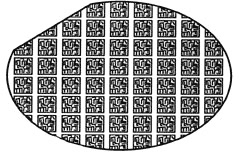
Cee® Hot Plates virtually eliminate the skin effect with thick films and substantially increase throughput. The chart below presents process examples for two commonly used resins: positive photoresist and polyimide. These figures should not be use as a rigid guideline, since the best method with a particular baking application can only be achieved through experimentation.
| Applications | Oven Bake | Hot Plate Bake |
|---|---|---|
| Positive Photo Resist | 90°C - 30 minutes | 115°C - 30 secs w/Hard Contact bake |
| Polyimide alpha (solvent removal) | 90°C - 30 minutes | 150°C - 15 secs w/Proximity bake |
| 135°C - 30 minutes | Polyimide beta (partial imidization) | 150°C - 90 secs w/Hard Contact bake |
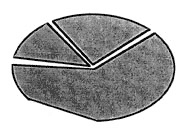
Segments and pieces of GaAs wafers are commonly used in research and pilot lines for economic reasons. The Cee® Hot Plates are ideally suited for these circumstances as all Cee® Hot Plates offer the proximity bake mode. This is most useful for prewarming GaAs wafers before going to a hard-contact bake and insures uniform heating without thermal shock. Typical bake processes are identical to those provided above, for silicon substrates.
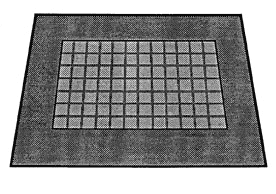
Reproducibility and throughput are key issues both for photomasks and for display makers. Because of the large thermal mass of these substrates, oven baking is slow and non-uniform. A proximity bake eliminates back side defects. The Cee® Hot Plate typically reduces bake times by 90%.
Reproducibility is greatly improved since the rate of heating is not dependent on batch size. All substrates are baked individually.
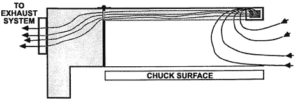
The design of the Cee® exhaust cover promotes the dissipation of vapors removed from a substrate placed on the chuck, without actually drawing air across the chuck surface.
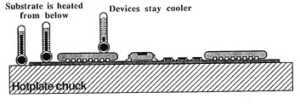
Hotplate baking heats the substrate and the solder without applying heat directly to the devices on the board. Using a combination of proximity and hard-contact bakes, the bake profile can be adjusted to suit any process.
Hotplate bake processing has increased in popularity since the early 1980s. Previously the most common technique for film drying and curing as the convection oven. Hotplates offer several advantages in the form of increased throughput, increased uniformity and reproducibility and decreased particle contamination. In a typical bake process the substrate is placed into contact with a heated surface of known temperature. The substrate quickly rises to a peak temperature slightly lower than the hotplate surface temperature. Drying and curing steps generally take about 1 minute. This is in contrast to traditional oven processes taking 30 minutes or more.
A typical bake process consists of preheating the surface to a known temperature, loading the substrate onto the surface for a specific length of time and removing it promptly at the end of the cycle. The selection of the temperature and time values used as well as the bake method employed all affect the overall performance of the process.
The bake temperature used is dependent on several factors. The material and substrate being baked as well as the results desired are key factors to be considered in developing a bake process.
In general hotplate baking will be performed at temperatures slightly higher than those used in oven bake processes. The film being baked will reach a temperature somewhere between the temperature of the hotplate and the ambient air above the film. As an example, with a hotplate surface temperature of 115°C, a layer of photoresist on a silicon wafer will reach a final temperature of about 105°C after a few seconds. Thicker substrates and/or substrates with lower coefficients of thermal conductivity will require even higher temperatures to compensate for this phenomenon.
Another reason for using higher temperatures is to increase process throughput. In oven processes there is a problem commonly known as the “skin effect”. This is a result of the outer exposed layer of the film drying and forming a skin before all of the solvents in lower layers have evaporated. Most oven processes are adjusted to use lower temperatures and bake times measured in minutes and hours to prevent this. During a hotplate bake process the film is baked from the bottom up thus preventing the formation of a skin over the surface. Because of this it is possible to increase temperatures and adjust bake times to be measured in seconds without danger of blistering or cracking in the film.
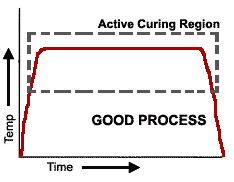
The selection of the bake time parameter plays an important role in the reproducibility of the bake process. Substrate thermal properties and the choice of bake method greatly affect the amount of time necessary for the substrate and therefore film temperature to stabilize during the bake. Thicker substrates and the use of proximity bake methods will increase the time necessary for the film to reach its final temperature. It is important that most of the baking action in the film takes place after this temperature is reached. A silicon wafer will reach a stable temperature within a few seconds and so it is traditional to adjust a photoresist bake processes to be completed in 60-90 seconds with an appropriate bake temperature.
For thicker substrates such as photomasks and ceramic modules the increased time necessary to heat the larger mass of the substrate results in bakes times Unstable Processapproaching five minutes. It should be noted that these substrates can be processed with higher temperature and much shorter bake times but reproducibility may suffer. If the bake time is too short then a significant amount of the actual bake process will take place during the loading and unloading steps as well as while the substrate is cooling after removal from the hotplate. This is an unstable condition since it is very difficult to exactly reproduce conditions during these steps.
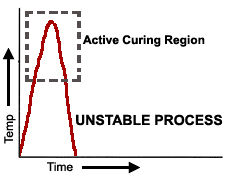
In general the temperature-time relationship in a bake process can be taken as a “dose” of the (temperature) x (time) product. Increasing the bake temperature results in a need for decreasing bake time. The limits for both of these parameters can be considered to be reached when the process is no longer reproducible or when the physical temperature limitations of the resin or substrate have been reached.
Another important factor is the method of bake. Cee® hotplates allow for three distinct bake methods. These are Proximity, Soft contact and Hard contact. The choice of bake method is programmable and up to three consecutive bake steps may be programmed into the onboard microcomputer.
 In a hard contact bake the substrate is clamped onto the hotplate surface by the application of vacuum to the underside of the substrate. Small holes are machined into the hotplate surface in a pattern which optimizes vacuum distribution without the formation of cold spots or warping of the substrate. This method is usually preferred for silicon and other flat substrates where back side contact is not a problem.
 Soft contact baking uses gravity alone to hold the substrate onto the hotplate. This method generally offers less uniformity since the substrate-hotplate thermal interface is not as efficient as in hard contact baking and can be somewhat random in variation.
 Proximity baking is accomplished by forcing heated gas (usually nitrogen) through the same ports in the hotplate surface that are used for vacuum in the hard contact method. This forces the substrate to float at a distance of one to four mils (25-100µm) above the hotplate surface. Proximity baking allows a slower warm-up than contact bake methods and can be advantageous when baking thick films where blistering would otherwise be a problem.
Another advantage of proximity baking in this manner is that in many cases cambered or warped substrates can be baked with a high degree of uniformity. This is usually not possible with the contact methods since it is not possible to achieve a vacuum under a substrate that is not flat to start with. Processing cambered substrates with the soft contact method creates hot spots where the substrate touches the hotplate and cold spots where it does not. It should be noted as well that this type of proximity process is “self-leveling” in that the substrate will tend to form a uniform gap to the hotplate surface. This is a significant advantage not found in “pin lift” type systems.
Proximity baking also offers the unique advantage of allowing hotplate processing without touching the bottom side of the substrate. An example of this application is photomask processing. In processing these relatively thick glass plates it is important that the back side of the glass not directly touch the hotplate since this causes micro-fractures in the glass itself from rapid heating. By performing the entire bake process in the proximity mode the integrity of the substrate is not endangered and the uniformity is excellent.
As with the spin coating process there are no absolute rules for hotplate baking, only general guidelines. Following is a list of issues to consider for specific hotplate process problems.
| Film Overbooked | |
|---|---|
| Bake temperature too high | Select lower temperature |
| Bake temperature too long | Decrease bake time |
| Film Underbaked | |
| Bake temperature too low | Select higher temperature |
| Bake time too short | Increase bake time |
| Film Blistering or Crackling | |
| Unstable balance in temp./ time parameters | Decrease temp./increase temp |
| Warm-up time too fast | Use proximity bake to preheat substrate |
| Non-uniform bake | |
| Unstable balance in temp./ time parameters | Decrease temp./increase temp |
| Operating with exhaust lid raised | Lower exhaust lid |
| Unstable ambient conditions | Protect against major functions |
| Bake time too short | Increase bake time |
| Hotplate surface contaminated | Clean surface of hot plate |